YUANFONG PRESS
 HALLMARKORG


Views: 0 Author: Site Editor Publish Time: 2026-08-12 Origin: Site


If you search "how does a short cycle hot press machine work," most of what comes back is a five-step summary that tells you almost nothing about what actually happens inside the press. That's fine if you just need the gist. It's not fine if you're specifying a production line, troubleshooting a bonding defect, or comparing quotes from three different factories and need to know what you're actually paying for.
This guide goes further. Below is the complete, mechanically accurate process a short cycle hot press machine runs through — from the moment a raw MDF or particleboard panel enters the line to the moment a finished, melamine-faced board is trimmed and stacked — along with the components that make it happen, the technical parameters that define a given model, and the questions buyers actually ask before they sign a purchase order.
A short cycle hot press machine (also called a short cycle hot press machine or short cycle hot laminating press) is a hydraulic press that bonds melamine-impregnated decor paper — or CPL, SPL, and similar overlay papers — directly onto a wood-based substrate such as MDF, particleboard, HDF, or plywood, using heat and pressure in a single, fast cycle. Unlike a multi-daylight press that stacks dozens of layers and runs a single long cycle, a short cycle machine is built around speed: modern lines such as BECCOR's KT Series Short Cycle Hot Press Line close in around 4 seconds and complete a full pressing cycle in 15–30 seconds, which is what gives the category its name.
The output is what the flooring, furniture, cabinetry, and door industries call "melamine faced board" (MFB) or "melamine faced MDF/particleboard" — the flat, decorative panels used in cabinets, furniture panels, laminate flooring cores, and interior doors.
Buyers researching this equipment often confuse three related but distinct press types. Here's how they actually differ:
| Feature | Short Cycle Hot Press Machine | Multi-Daylight(Multi-Opening )Hot Press Machine |
| Typical cycle time | 15–30 seconds | 4–10 minutes |
| Typical product | Melamine faced MDF/PB, CPL/SPL board, door skins | Multi-layer plywood, HPL laminate stacks |
| Layers pressed at once | Single opening (or a few, on multi-daylight short-cycle variants) | Many openings stacked (10–30+) |
| Pressure range | ~40–100 kg/cm² (model dependent) | Often higher, for dense HPL stacks |
| Best suited for | Fast-turnaround decorative panel and flooring lines | Batch production of plywood and laminate sheets |
If your production goal is decorative melamine board, laminate flooring cores, or door skins at high throughput, a short cycle line is almost always the right category — see BECCOR's full Short Cycle Hot Press Line for CPL/SPL for a variant built specifically around impregnated overlay papers rather than raw melamine paper.
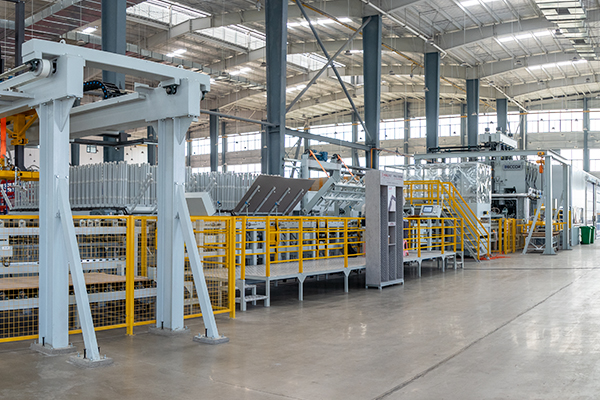
A short cycle press is never really "one machine" — it's a coordinated line. Before walking through the process, it helps to know what's actually doing the work at each stage:
Hot press frame and platens — a solid steel frame (commonly Q345 steel, CNC-machined for flatness) holding the upper and lower heated platens that actually contact the board.
Hydraulic station and plunger cylinders — typically 6–8 plunger cylinders per platen (φ320–450 mm on larger models) generate and hold clamping pressure. Servo-driven hydraulic pumps, now standard on efficient lines, cut electricity use by roughly 30% versus fixed-speed pumps.
Thermal oil (or electric/steam) heating circuit — circulates heated thermal oil through channels in the platens, with multi-zone control holding temperature uniformity within about ±1°C across the full platen surface.
PLC and servo control system — a Siemens PLC (or equivalent) manages pressure curves, temperature setpoints, dwell time, and platen synchronization; the servo motor controls closing speed and force precisely instead of relying on fixed hydraulic flow.
Paper laying machine — automatically positions melamine, CPL, or SPL sheets on top of (and beneath) each substrate board before it enters the press.
EIR synchronized camera system — on textured lines, an Embossed-in-Register camera aligns the printed wood-grain pattern with the embossed press plate so the texture and print register correctly.
Loading, unloading, and stacking systems — vacuum manipulator loaders, board separators, and robotic stacking (BECCOR's S-E series) move boards on and off the line without manual handling.
Cooling line — a conveyor or cooling station that stabilizes panel temperature before stacking, preventing warping.
Press plate accessories — stainless steel press plates provide the mirror, matte, or textured finish transferred onto the board, while a cushion pad sits between the plate and platen to equalize pressure across the full board surface.
This is the part most articles compress into three or four vague steps. In an actual production line, here is what happens, in order:
Raw material inspection and preparation. Substrate boards (MDF, particleboard, HDF, or plywood) and decor paper are checked for moisture content, thickness tolerance, and surface defects before entering the line. Paper that was produced on a melamine paper impregnation line needs to have reached the correct resin content and dryness, or the finished board will show bubbling or poor bond strength later.
Board loading and dust removal. A vacuum manipulator lifts each substrate panel onto the infeed conveyor. A double-sided dust cleaner then removes dust and debris from both faces — even small particles will telegraph through the paper as visible defects once pressed, so this step directly affects final surface grade.
Automatic paper laying. The paper laying machine positions a sheet of melamine-impregnated decor paper (or CPL/SPL overlay) precisely on top of the substrate, with a matching sheet on the underside for balanced construction. On textured product lines, the EIR synchronized camera checks pattern alignment before the board proceeds.
Book-building and transfer into the press. The loaded board — now referred to as a "book" or layup — is carried into the press bay by a loading carriage. Depending on whether the line is a single-opening KT Series machine or a multi-opening HKT Series Short Cycle Hot Press Line, one or several books are positioned between the heated platens simultaneously.
Rapid press closing. The hydraulic station drives the main cylinders to close the platens quickly onto the layup — on BECCOR's KT series this rapid approach takes about 4 seconds. Closing fast matters: it minimizes the time the resin sits at partial temperature before full pressure is reached, which keeps curing consistent across the board.
Heat application. The thermal oil circuit inside each platen brings the contact surface up to the resin's activation temperature, typically in the 150–200°C range depending on the specific melamine formulation and board type. Multi-zone thermal control keeps this uniform (±1°C) so one side of the board doesn't cure faster than the other.
Full pressure and dwell (the actual bonding stage). The plunger cylinders apply full clamping pressure — commonly configurable between 40 and 100 kg/cm² depending on model and product — and hold it for the programmed dwell time. Under combined heat and pressure, the thermosetting melamine-formaldehyde resin melts, flows into the surface pores of the substrate, and begins cross-linking. This dwell is typically just 15–30 seconds on a short cycle line, versus several minutes on a multi-daylight press — it's the defining difference for the entire equipment category.
Pressure release and controlled opening. Once the PLC's programmed cure timer completes, the press opens in a controlled sequence rather than all at once. This matters more than it sounds: opening too abruptly can trap steam or off-gassing under the paper and cause blistering or delamination.
Cooling and stabilization. Finished panels move onto the cooling line before stacking. Letting the board release internal heat and stress gradually — rather than stacking it hot — is what prevents the warping and cracking that shows up days later if this step is rushed.
Unloading, separation, and stacking. A board separator and automatic/robotic stacking system unload the panels, separate any interleaving sheets, and square-stack them for the next stage. Frame components like the board turnover machine are often used here to flip boards for double-sided inspection.
Trimming, inspection, and packing. Edges are trimmed to final dimension, and panels pass visual or automated inspection for gloss level, texture registration, and glueline defects before packing — commonly with a smart film packing machine and an anti-counterfeit code printer for batch traceability and brand protection.
Actual specifications vary by manufacturer and tonnage class, but here's a representative range based on BECCOR's KT/HKT series to give you real numbers to benchmark quotes against:
| Parameters | Typical Rang |
| Pressing tonnage | 1200T – 3200T+ (12,000–32,000+ KN) |
| Board size | 1220×2440 mm up to 2100×3660 mm (custom sizes available) |
| Cycle time | 15–30 seconds |
| Production capacity | Up to 120–180 cycles/hour |
| Plunger cylinders | 6–8 per platen, φ320–450 mm |
| Specific pressure | 40–100 kg/cm² (configurable by model) |
| Temperature control accuracy | ±1°C, multi-zone thermal oil circuit |
| Press closing speed | ~4 seconds (rapid approach) |
Reliable production isn't just about running the cycle — it's about verifying it at specific points:
Before pressing: substrate moisture content and paper resin content are within spec; dust-free surface confirmed.
At closing: platen parallelism and cylinder synchronization checked (an out-of-sync cylinder shows up immediately as uneven pressure marks).
During dwell: temperature and pressure curves logged by the PLC and compared against the programmed recipe for that board type.
At opening: visual check for surface blistering, edge chipping, or incomplete cure (a dull, tacky surface usually means under-curing).
After cooling: gloss level, texture registration, and panel flatness measured before the board is approved for trimming and packing.
The same core process — heat, pressure, brief dwell — is adapted across several related product lines depending on the substrate and overlay material:
Melamine faced board for furniture, cabinetry, and wardrobes
Laminate flooring cores, often paired with a Film/Melamine Faced Plywood Press Machine for plywood-core products
Interior door skins, typically run on a dedicated Door Skin Press Machine
Decorative wall panels, including textured product from a 3D Membrane Press Line
Veneer-faced panels, produced on a Veneer Lamination Production Line using the same heat-and-pressure principle with real wood veneer instead of paper
Once you understand the process, evaluating a short cycle hot press machine manufacturer or short cycle hot press machine supplier becomes a lot more concrete. A few things worth checking before you request a quote:
Component brands — presses built around recognized control and drive brands (Siemens PLC and servo motors, for example) are generally easier to service and source spare parts for long-term.
Certifications — CE and ISO 9001 are baseline indicators of manufacturing and quality-system discipline for a short cycle hot press machine factory.
Frame and cylinder specifications — ask for actual steel grade, cylinder diameter, and number of cylinders rather than accepting "heavy duty" as a spec.
Real installations — a China short cycle hot press machine manufacturer with verifiable projects across multiple countries and climates is a stronger bet than one with only local references.
After-sales support — on-site installation, commissioning, and warranty terms matter more over a 10-year machine lifespan than a small difference in short cycle hot press machine price upfront.
BECCOR, established in 2007 and now a 130-person engineering team, builds its KT and HKT series around Siemens PLC and servo control, Q345 steel frames, and CE/ISO 9001 certification, with equipment running in more than 50 countries. You can see the full specification range on the KT Series product page or read more about the company on the About Us page.
1.How long does one short cycle hot press cycle actually take?
Typically 15–30 seconds for the pressing dwell itself, with the full loading-to-unloading cycle depending on line automation level. This is what distinguishes it from a multi-daylight press, which can take several minutes per cycle.
2.What temperature does a short cycle hot press machine run at?
Most melamine lamination runs in the 150–200°C range at the platen surface, with the exact figure depending on the resin supplier's recommended cure profile and board thickness.
3.What's the difference between a short cycle press and a multi-daylight press?
A short cycle press runs a fast, single (or few-opening) cycle optimized for melamine/overlay board; a multi-daylight press stacks many layers and runs one long cycle, better suited to plywood or HPL batch production. See the comparison table above for a full breakdown.
4.What boards and materials can a short cycle hot press machine handle?
MDF, particleboard, HDF, and plywood substrates, paired with melamine paper, CPL, SPL, or specialty foils — and, on a veneer lamination line, real wood veneer.
5.How much does a short cycle hot press machine cost?
Price depends heavily on tonnage, board size, automation level (manual vs. fully robotic loading/unloading), cylinder count, and control system brand, so quotes can vary widely between a basic semi-automatic unit and a full automatic line. The most reliable way to compare is to request a quote with your target board size and output volume specified.
6.How do I test a resin or paper combination before committing to full production?
Most manufacturers, including BECCOR, offer a Laboratory Press Machine specifically for small-batch trials, so you can validate temperature, pressure, and dwell settings before scaling up to a full production line.